A) $100*(1 + r)
B) $100/(1 + r)
C) $100 - $100  r
r
D) $100 - (1 + r) /$100
F) A) and C)
Correct Answer

verified
Correct Answer
verified
A) $100(1 + .0410)
B) $100(1 + .04  10)
10)
C) $100 × 10  (1 + .04)
D) $100(1 + .04) 10
F) A) and C)
Correct Answer
verified
Correct Answer
verified
A) $747.66
B) $756.00
C) $856.00
D) None of the above are correct to the nearest cent.
F) A) and B)
Correct Answer
verified
Correct Answer
verified
B) False
Correct Answer
verified
Correct Answer
verified
A) financial firms acted in too risky a fashion.
B) the Federal Reserve's efforts to rein in the risky behavior of certain financial firms were inadequate.
C) falling house prices "crashed the banks and the economy."
D) All of the above are correct.
F) A) and B)
Correct Answer
verified
Correct Answer
verified
A) 5 percent
B) 7 percent
C) 8 percent
D) 10 percent
F) A) and C)
Correct Answer
verified
Correct Answer
verified
A) 3 percent
B) 5 percent
C) 7 percent
D) 9 percent
F) None of the above
Correct Answer
verified
Correct Answer
verified
A) the risk of the portfolio increases, as indicated by the increasing value of the standard deviation of the portfolio.
B) the risk of the portfolio increases, as indicated by the decreasing value of the standard deviation of the portfolio.
C) the risk of the portfolio decreases, as indicated by the increasing value of the standard deviation of the portfolio.
D) the risk of the portfolio decreases, as indicated by the decreasing value of the standard deviation of the portfolio.
F) None of the above
Correct Answer
verified
Correct Answer
verified
B) False
Correct Answer
verified
Correct Answer
verified
A) market risk by more than an increase from 110 to 120.
B) market risk by less than an increase from 110 to 120.
C) firm-specific risk by more than an increase from 110 to 120.
D) firm-specific risk by less than an increase from 110 to 120.
F) All of the above
Correct Answer
verified
Correct Answer
verified
Which of the following is the correct way to compute the future value of $1 put into an account that earns 5 percent interest for 16 years? 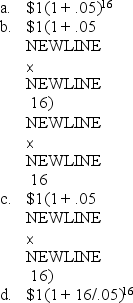
) undefined
Correct Answer
verified
Correct Answer
verified
A) an increase in the size of the payment
B) an increase in the time until the payment is made
C) a decrease in the interest rate
D) All of the above are correct.
F) A) and C)
Correct Answer
verified
Correct Answer
verified
A) $515
B) $520
C) $530
D) None of the above is correct.
F) A) and C)
Correct Answer
verified
Correct Answer
verified
B) False
Correct Answer
verified
Correct Answer
verified
Correct Answer
verified
An example of adverse selection is that ...View Answer
Correct Answer
verified
View Answer
A) 70/(1 - r) years.
B) 70/(1 + r) years.
C) 70/r years.
D) 70(1 + r) /r years.
F) C) and D)
Correct Answer
verified
Correct Answer
verified
A) 4.7 percent
B) 5.1 percent
C) 5.5 percent
D) 5.9 percent
F) None of the above
Correct Answer
verified
Correct Answer
verified
Correct Answer
verified
A risk-averse person can reduce risk by ...View Answer
Correct Answer
verified
View Answer
A) Bubbles could arise, in part, because the price that people pay for stock depends on what they think someone else will pay for it in the future.
B) Economists almost all agree that the evidence for stock market irrationality is convincing and the departures from rational pricing are important.
C) Some evidence for the existence of market irrationality is that informed and presumably rational managers of mutual funds generally beat the market.
D) All of the above are correct.
F) A) and C)
Correct Answer
verified
Correct Answer
verified
A) 8 years
B) 10 years
C) 12 years
D) 14 years
F) All of the above
Correct Answer
verified
Correct Answer
verified
Showing 441 - 460 of 500
Related Exams