Filters
Question type

Study Flashcards

Table 3-27 Assume that Huang and Min can switch between producing parasols and producing porcelain plates at a constant rate. ​ Table 3-27 Assume that Huang and Min can switch between producing parasols and producing porcelain plates at a constant rate. ​   -Refer to Table 3-27. Huang has an absolute advantage in the production of A) parasols and a comparative advantage in the production of parasols. B) parasols and a comparative advantage in the production of plates. C) neither good and a comparative advantage in the production of parasols. D) neither good and a comparative advantage in the production of plates. -Refer to Table 3-27. Huang has an absolute advantage in the production of


A) parasols and a comparative advantage in the production of parasols.
B) parasols and a comparative advantage in the production of plates.
C) neither good and a comparative advantage in the production of parasols.
D) neither good and a comparative advantage in the production of plates.

E) None of the above
F) A) and B)

Correct Answer

verifed

verified

Table 3-25 Assume that Maya and Miguel can switch between producing mixers and producing toasters at a constant rate. ​ Table 3-25 Assume that Maya and Miguel can switch between producing mixers and producing toasters at a constant rate. ​   -Refer to Table 3-25. The opportunity cost of 1 toaster for Maya is A) 0.625 mixers. B) 1.6 hours of labor. C) 1.6 mixers. D) 8 hours of labor. -Refer to Table 3-25. The opportunity cost of 1 toaster for Maya is


A) 0.625 mixers.
B) 1.6 hours of labor.
C) 1.6 mixers.
D) 8 hours of labor.

E) B) and D)
F) A) and B)

Correct Answer

verifed

verified

Figure 3-20 Canada's Production Possibilities Frontier Mexico's Production Possibilities Frontier Figure 3-20 Canada's Production Possibilities Frontier Mexico's Production Possibilities Frontier     -Refer to Figure 3-20. Canada would incur an opportunity cost of 6 units of Good X if it increased its production of Good Y by A) 3 units. B) 6 units. C) 9 units. D) 12 units. Figure 3-20 Canada's Production Possibilities Frontier Mexico's Production Possibilities Frontier     -Refer to Figure 3-20. Canada would incur an opportunity cost of 6 units of Good X if it increased its production of Good Y by A) 3 units. B) 6 units. C) 9 units. D) 12 units. -Refer to Figure 3-20. Canada would incur an opportunity cost of 6 units of Good X if it increased its production of Good Y by


A) 3 units.
B) 6 units.
C) 9 units.
D) 12 units.

E) All of the above
F) A) and B)

Correct Answer

verifed

verified

Under what conditions is an economy's production possibilities frontier also its consumption possibilities frontier?

Correct Answer

verifed

verified

When the economy is ...

View Answer

Table 3-36 Table 3-36   -Refer to Table 3-36. What is Barbuda's opportunity cost of one towel? A) 3/5 umbrellas B) 2/3 umbrellas C) 3/2 umbrellas D) 5/3 umbrellas -Refer to Table 3-36. What is Barbuda's opportunity cost of one towel?


A) 3/5 umbrellas
B) 2/3 umbrellas
C) 3/2 umbrellas
D) 5/3 umbrellas

E) A) and D)
F) B) and D)

Correct Answer

verifed

verified

Table 3-5 Assume that Aruba and Iceland can switch between producing coolers and producing radios at a constant rate. Table 3-5 Assume that Aruba and Iceland can switch between producing coolers and producing radios at a constant rate.   -Refer to Table 3-5. Which of the following combinations of coolers and radios could Aruba produce in one 40-hour week? A) 3 coolers and 7 radios B) 5 coolers and 6 radios C) 11 coolers and 4 radios D) 13 coolers and 3 radios -Refer to Table 3-5. Which of the following combinations of coolers and radios could Aruba produce in one 40-hour week?


A) 3 coolers and 7 radios
B) 5 coolers and 6 radios
C) 11 coolers and 4 radios
D) 13 coolers and 3 radios

E) None of the above
F) B) and D)

Correct Answer

verifed

verified

If Korea is capable of producing either shoes or soccer balls or some combination of the two, then


A) Korea should specialize in the product in which it has an absolute advantage.
B) it would be impossible for Korea to have an absolute advantage over another country in both products.
C) it would be difficult for Korea to benefit from trade with another country if Korea is efficient in the production of both goods.
D) Korea's opportunity cost of shoes is the inverse of its opportunity cost of soccer balls.

E) None of the above
F) A) and B)

Correct Answer

verifed

verified

Figure 3-7 Bintu's Production Possibilities Frontier Juba's Production Possibilities Frontier Figure 3-7 Bintu's Production Possibilities Frontier Juba's Production Possibilities Frontier     -Refer to Figure 3-7. If the production possibilities frontiers shown are each for 4 hours of work, then which of the following combinations of bowls and cups could Bintu and Juba together make in a given 4-hour production period? A) 1 bowl and 14 cups B) 2 bowls and 11 cups C) 3 bowls and 10 cups D) 5 bowls and 5 cups Figure 3-7 Bintu's Production Possibilities Frontier Juba's Production Possibilities Frontier     -Refer to Figure 3-7. If the production possibilities frontiers shown are each for 4 hours of work, then which of the following combinations of bowls and cups could Bintu and Juba together make in a given 4-hour production period? A) 1 bowl and 14 cups B) 2 bowls and 11 cups C) 3 bowls and 10 cups D) 5 bowls and 5 cups -Refer to Figure 3-7. If the production possibilities frontiers shown are each for 4 hours of work, then which of the following combinations of bowls and cups could Bintu and Juba together make in a given 4-hour production period?


A) 1 bowl and 14 cups
B) 2 bowls and 11 cups
C) 3 bowls and 10 cups
D) 5 bowls and 5 cups

E) A) and C)
F) C) and D)

Correct Answer

verifed

verified

It is possible for the U.S. to gain from trade with Germany even if it takes U.S. workers fewer hours to produce every good than it takes German workers.

A) True
B) False

Correct Answer

verifed

verified

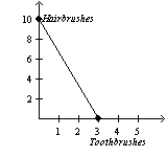
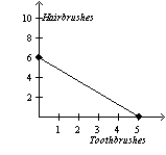
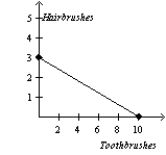
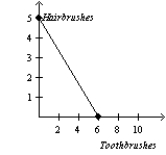
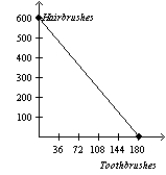
Table 3-6 Assume that Zimbabwe and Portugal can switch between producing toothbrushes and producing hairbrushes at a constant rate. Table 3-6 Assume that Zimbabwe and Portugal can switch between producing toothbrushes and producing hairbrushes at a constant rate.   -Refer to Table 3-6. Which of the following represents Zimbabwe's and Portugal's production possibilities frontiers when each country has 60 minutes of machine time available? A) Zimbabwe Portugal     B) Zimbabwe Portugal     C) Zimbabwe Portugal     D) Zimbabwe Portugal    -Refer to Table 3-6. Which of the following represents Zimbabwe's and Portugal's production possibilities frontiers when each country has 60 minutes of machine time available?

A) Zimbabwe Portugal Table 3-6 Assume that Zimbabwe and Portugal can switch between producing toothbrushes and producing hairbrushes at a constant rate.   -Refer to Table 3-6. Which of the following represents Zimbabwe's and Portugal's production possibilities frontiers when each country has 60 minutes of machine time available? A) Zimbabwe Portugal     B) Zimbabwe Portugal     C) Zimbabwe Portugal     D) Zimbabwe Portugal    Table 3-6 Assume that Zimbabwe and Portugal can switch between producing toothbrushes and producing hairbrushes at a constant rate.   -Refer to Table 3-6. Which of the following represents Zimbabwe's and Portugal's production possibilities frontiers when each country has 60 minutes of machine time available? A) Zimbabwe Portugal     B) Zimbabwe Portugal     C) Zimbabwe Portugal     D) Zimbabwe Portugal
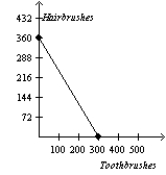
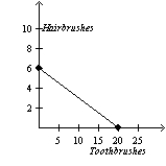
B) Zimbabwe Portugal Table 3-6 Assume that Zimbabwe and Portugal can switch between producing toothbrushes and producing hairbrushes at a constant rate.   -Refer to Table 3-6. Which of the following represents Zimbabwe's and Portugal's production possibilities frontiers when each country has 60 minutes of machine time available? A) Zimbabwe Portugal     B) Zimbabwe Portugal     C) Zimbabwe Portugal     D) Zimbabwe Portugal    Table 3-6 Assume that Zimbabwe and Portugal can switch between producing toothbrushes and producing hairbrushes at a constant rate.   -Refer to Table 3-6. Which of the following represents Zimbabwe's and Portugal's production possibilities frontiers when each country has 60 minutes of machine time available? A) Zimbabwe Portugal     B) Zimbabwe Portugal     C) Zimbabwe Portugal     D) Zimbabwe Portugal
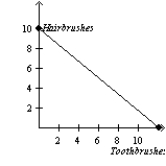
C) Zimbabwe Portugal Table 3-6 Assume that Zimbabwe and Portugal can switch between producing toothbrushes and producing hairbrushes at a constant rate.   -Refer to Table 3-6. Which of the following represents Zimbabwe's and Portugal's production possibilities frontiers when each country has 60 minutes of machine time available? A) Zimbabwe Portugal     B) Zimbabwe Portugal     C) Zimbabwe Portugal     D) Zimbabwe Portugal    Table 3-6 Assume that Zimbabwe and Portugal can switch between producing toothbrushes and producing hairbrushes at a constant rate.   -Refer to Table 3-6. Which of the following represents Zimbabwe's and Portugal's production possibilities frontiers when each country has 60 minutes of machine time available? A) Zimbabwe Portugal     B) Zimbabwe Portugal     C) Zimbabwe Portugal     D) Zimbabwe Portugal
D) Zimbabwe Portugal Table 3-6 Assume that Zimbabwe and Portugal can switch between producing toothbrushes and producing hairbrushes at a constant rate.   -Refer to Table 3-6. Which of the following represents Zimbabwe's and Portugal's production possibilities frontiers when each country has 60 minutes of machine time available? A) Zimbabwe Portugal     B) Zimbabwe Portugal     C) Zimbabwe Portugal     D) Zimbabwe Portugal    Table 3-6 Assume that Zimbabwe and Portugal can switch between producing toothbrushes and producing hairbrushes at a constant rate.   -Refer to Table 3-6. Which of the following represents Zimbabwe's and Portugal's production possibilities frontiers when each country has 60 minutes of machine time available? A) Zimbabwe Portugal     B) Zimbabwe Portugal     C) Zimbabwe Portugal     D) Zimbabwe Portugal

E) C) and D)
F) B) and C)

Correct Answer

verifed

verified

Table 3-3 Production Opportunities Table 3-3 Production Opportunities   ​ -Refer to Table 3-3. Assume that England and France each has 40 labor hours available. If each country divides its time equally between the production of cheese and wine, then total production is A) 8 units of cheese and 10 units of wine B) 24 units of cheese and 15 units of wine C) 40 units of cheese and 20 units of wine D) 48 units of cheese and 30 units of wine ​ -Refer to Table 3-3. Assume that England and France each has 40 labor hours available. If each country divides its time equally between the production of cheese and wine, then total production is


A) 8 units of cheese and 10 units of wine
B) 24 units of cheese and 15 units of wine
C) 40 units of cheese and 20 units of wine
D) 48 units of cheese and 30 units of wine

E) None of the above
F) C) and D)

Correct Answer

verifed

verified

Table 3-26 Assume that Japan and Korea can switch between producing cars and producing airplanes at a constant rate. ​ Table 3-26 Assume that Japan and Korea can switch between producing cars and producing airplanes at a constant rate. ​   -Refer to Table 3-26. Suppose Korea decides to increase its production of cars by 18. What is the opportunity cost of this decision? A) 3 airplanes B) 6 airplanes C) 16 airplanes D) 150 airplanes -Refer to Table 3-26. Suppose Korea decides to increase its production of cars by 18. What is the opportunity cost of this decision?


A) 3 airplanes
B) 6 airplanes
C) 16 airplanes
D) 150 airplanes

E) C) and D)
F) A) and B)

Correct Answer

verifed

verified

Figure 3-19 Chile's Production Possibilities Frontier Colombia's Production Possibilities Frontier Figure 3-19 Chile's Production Possibilities Frontier Colombia's Production Possibilities Frontier     -Refer to Figure 3-19. Chile has an absolute advantage in the production of A) coffee and Colombia has an absolute advantage in the production of soybeans. B) soybeans and Colombia has an absolute advantage in the production of coffee. C) both goods and Colombia has an absolute advantage in the production of neither good. D) neither good and Colombia has an absolute advantage in the production of both goods. Figure 3-19 Chile's Production Possibilities Frontier Colombia's Production Possibilities Frontier     -Refer to Figure 3-19. Chile has an absolute advantage in the production of A) coffee and Colombia has an absolute advantage in the production of soybeans. B) soybeans and Colombia has an absolute advantage in the production of coffee. C) both goods and Colombia has an absolute advantage in the production of neither good. D) neither good and Colombia has an absolute advantage in the production of both goods. -Refer to Figure 3-19. Chile has an absolute advantage in the production of


A) coffee and Colombia has an absolute advantage in the production of soybeans.
B) soybeans and Colombia has an absolute advantage in the production of coffee.
C) both goods and Colombia has an absolute advantage in the production of neither good.
D) neither good and Colombia has an absolute advantage in the production of both goods.

E) C) and D)
F) A) and D)

Correct Answer

verifed

verified

Table 3-41 ​ ​ Table 3-41 ​ ​   -Refer to Table 3-41. Which country has a comparative advantage in producing compasses? -Refer to Table 3-41. Which country has a comparative advantage in producing compasses?

Correct Answer

verifed

verified

Suppose the U.S. and Japan can both produce airplanes and televisions and the U.S. has a comparative advantage in the production of airplanes while Japan has a comparative advantage in the production of televisions. Also suppose the U.S. has an absolute advantage in the production of both airplanes and televisions. The U.S. should


A) not trade airplanes or televisions with Japan.
B) import airplanes from Japan and export televisions to Japan.
C) export airplanes to Japan and import televisions from Japan.
D) export both airplanes and televisions to Japan.

E) B) and C)
F) A) and D)

Correct Answer

verifed

verified

Table 3-21 Assume that Jamaica and Norway can switch between producing coolers and producing radios at a constant rate. The following table shows the number of coolers or number of radios each country can produce in one day. Table 3-21 Assume that Jamaica and Norway can switch between producing coolers and producing radios at a constant rate. The following table shows the number of coolers or number of radios each country can produce in one day.   -Refer to Table 3-21. Assume that Jamaica and Norway each has 4 days available for production. Originally, each country divided its time equally between the production of coolers and radios. Now, each country spends all its time producing the good in which it has a comparative advantage. As a result, the total output of coolers increased by A) 12. B) 24. C) 36. D) 48. -Refer to Table 3-21. Assume that Jamaica and Norway each has 4 days available for production. Originally, each country divided its time equally between the production of coolers and radios. Now, each country spends all its time producing the good in which it has a comparative advantage. As a result, the total output of coolers increased by


A) 12.
B) 24.
C) 36.
D) 48.

E) C) and D)
F) A) and B)

Correct Answer

verifed

verified

Table 3-22 Assume that Zimbabwe and Portugal can switch between producing toothbrushes and producing hairbrushes at a constant rate. Table 3-22 Assume that Zimbabwe and Portugal can switch between producing toothbrushes and producing hairbrushes at a constant rate.   -Refer to Table 3-22. Zimbabwe's opportunity cost of one hairbrush is A) 3/10 toothbrush and Portugal's opportunity cost of one hairbrush is 5/6 toothbrush. B) 3/10 toothbrush and Portugal's opportunity cost of one hairbrush is 6/5 toothbrushes. C) 10/3 toothbrushes and Portugal's opportunity cost of one hairbrush is 5/6 toothbrush. D) 10/3 toothbrushes and Portugal's opportunity cost of one hairbrush is 6/5 toothbrushes. -Refer to Table 3-22. Zimbabwe's opportunity cost of one hairbrush is


A) 3/10 toothbrush and Portugal's opportunity cost of one hairbrush is 5/6 toothbrush.
B) 3/10 toothbrush and Portugal's opportunity cost of one hairbrush is 6/5 toothbrushes.
C) 10/3 toothbrushes and Portugal's opportunity cost of one hairbrush is 5/6 toothbrush.
D) 10/3 toothbrushes and Portugal's opportunity cost of one hairbrush is 6/5 toothbrushes.

E) B) and C)
F) A) and B)

Correct Answer

verifed

verified

Consider two individuals - Marquis and Serena - each of whom would like to wear sweaters and eat tasty food. The gains from trade between Marquis and Serena are most obvious in which of the following cases?


A) Marquis is very good at knitting sweaters and at cooking tasty food, but Serena's skills in both of these activities are very poor.
B) Marquis and Serena both are very good at cooking tasty food, but neither has the necessary skills to knit a sweater.
C) Marquis's cooking and knitting skills are very poor, and Serena's cooking and knitting skills are also very poor.
D) Marquis's skills are such that he can produce only sweaters, and Serena's skills are such that she can produce only tasty food.

E) A) and B)
F) C) and D)

Correct Answer

verifed

verified

Table 3-36 Table 3-36   -Refer to Table 3-36. Antigua has a comparative advantage in the production of A) towels and Barbuda has a comparative advantage in the production of umbrellas. B) umbrellas and Barbuda has a comparative advantage in the production of towels. C) both goods and Barbuda has a comparative advantage in the production of neither good. D) neither good and Barbuda has a comparative advantage in the production of both goods. -Refer to Table 3-36. Antigua has a comparative advantage in the production of


A) towels and Barbuda has a comparative advantage in the production of umbrellas.
B) umbrellas and Barbuda has a comparative advantage in the production of towels.
C) both goods and Barbuda has a comparative advantage in the production of neither good.
D) neither good and Barbuda has a comparative advantage in the production of both goods.

E) A) and B)
F) All of the above

Correct Answer

verifed

verified

Figure 3-4 Lisa's Production Possibilities Frontier Bryce's Production Possibilities Frontier Figure 3-4 Lisa's Production Possibilities Frontier Bryce's Production Possibilities Frontier     -Refer to Figure 3-4. If Bryce must work 4 months to produce each sweater, then his production possibilities frontier is based on how many months of work? A) 4 months B) 8 months C) 12 months D) 16 months Figure 3-4 Lisa's Production Possibilities Frontier Bryce's Production Possibilities Frontier     -Refer to Figure 3-4. If Bryce must work 4 months to produce each sweater, then his production possibilities frontier is based on how many months of work? A) 4 months B) 8 months C) 12 months D) 16 months -Refer to Figure 3-4. If Bryce must work 4 months to produce each sweater, then his production possibilities frontier is based on how many months of work?


A) 4 months
B) 8 months
C) 12 months
D) 16 months

E) A) and B)
F) A) and D)

Correct Answer

verifed

verified

Showing 281 - 300 of 550

Related Exams

Show Answer